
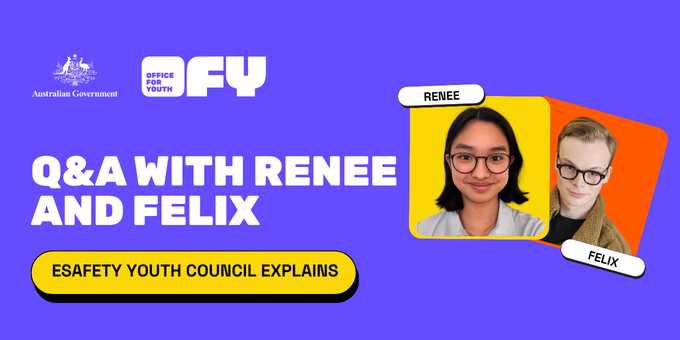
In 2022, the eSafety Commissioner (eSafety) established their eSafety Youth Council.
Their aim was to give young people the opportunity to influence policy and program design by shaping online safety education and addressing emerging issues.
The Council is made up a group of young people from all around Australia, with different lived experiences and cultures, aged 13 to 24. We spoke with members Renee and Felix about their role on the Council, their achievements, and what their top tips are to stay safe online. Check out our Q&A below!
OFY: What inspired you to join the eSafety Youth Council?
Renee: I stumbled across the eSafety Youth Council and instantly knew I wanted to be part of it. I was inspired by the opportunity to help create meaningful change, reduce online harms and positively shape this rapidly changing space.
Felix: What inspired me to join the eSafety Youth Council was the opportunity to draw on our own experiences and perspectives to provide advice on issues we’re passionate about.
OFY: What is your favourite part of being on the Council? What do you hope to achieve?
Felix: My favourite part about being on the Council is knowing that what we say won’t go to waste. Everything is taken into account and saved in a figurative “box” of ideas and solutions that the government can learn from.
OFY: Why is it important for governments to include young people in decisions that affect them online?
Renee: Although conducting research and studies are helpful, it doesn’t come close to hearing and understanding the first-hand experiences and perspectives of young people. By including young people in government decisions, we make room for informed and nuanced discussion of issues, reduce policy blind-spots, and can more accurately construct a picture of what it means to be a young Australian in the digital space.
OFY: What are your tips to young people to stay safe online?
Renee: Always recognise that everything on the internet is put out there for a particular reason and a purpose. Being wary that someone’s, or something’s, true intentions may not always be readily apparent is a helpful mantra to protect yourself from bad actors online.
Felix: I strongly recommend being careful with information and content, especially algorithmic-based news. Ask yourself: Am I believing this because it confirms what I want to see or hear? Is the title or thumbnail designed to draw my attention or be factual?
Thank you so much to Felix and Renee for your time!
If you want to find out more about the Council’s achievements, like how they’ve provided insights on the barriers to reporting online harm for young people, the impacts of age verification and age assurance mechanisms on young people, and impacts of gaming on young people and their communities, then make sure to follow the eSafety Commissioner on social media or visit their website.